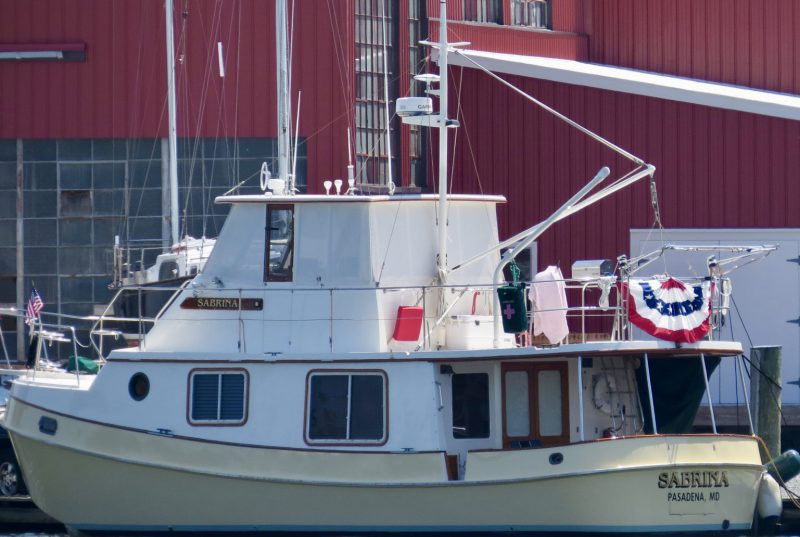
Just so you don’t think it’s all fun and games, this post is about a few chores that need to be taken care of along the way.
Some of those chores are: pump outs, laundry, engine checks and maintenance, filling the water tanks, house cleaning, exterior cleaning, canvas repair, provisioning, etc. Just to name a few.
“It’s an adventure, not a vacation.”
Pump outs: Sabrina has a 50 gallon black water holding tank. Black water is basically sewage waste from the toilet. yuck. It’s what allows us to use the restroom without pumping it overboard. That is a very good thing. Now, if you’re 3 miles out from shore I think you can dump it overboard. There are diverter valves below to facilitate this. We’ve not been that far out or needed to do that.
We typically try to use the restrooms at the marina bathhouse whenever possible. But, let’s face it, if it’s raining or it’s in the middle of the night I’m not putting on shoes/clothes and running up to a bathhouse. Or if we are underway. And some bathhouses are nicer than others. A few are sort of like an old KOA campground bathhouse. Some are a lot nicer. Some (not that we’ve been there yet) are really nice! Think sauna and hot tub. They all typically have shower stalls as well. This is great for sailboaters that usually have incredibly small showers on board. And it keeps you from using the water in your freshwater tanks.
We have a tank monitor that tells us how full the holding tank is. When the tank is full the toilet will not flush. When that happens, it’s time to pump out. We generally pump out before that happens. Most marinas have a pump out station you pull up to for this. It involves tying up next to the pump, unlocking the tank access cover and taking the top off (secure the top so it DOES NOT FALL IN THE WATER), insert the vacuum nozzle into the tank access making sure you have a snug fit and turn on the pump. Not to be too indelicate, but there is usually a clear plastic section so you can see what you are pumping out. Again, yuck. When you are not pumping any more out you can add fresh water and pump that out to help keep things nice and clean smelling. Put the top back on that you have securely placed somewhere safe so it DID NOT FALL IN THE WATER. When you’re putting the top back on make sure it DOES NOT FALL IN THE WATER. Then you are done. There’s usually a nominal fee for this. Say, about $5 and a tip for the dockhand if they do it for you. This is probably the same routine as RV’s and campers. Just to be clear, ours has not yet fallen in the water.
Soooo, our tank went from about half full yesterday to full a lot faster than usual. hmmm… Just need to pump out, right? Well, we are side tied up pretty tight here on a face dock on our port side. That means a dock on one side nothing on the other side. And we have an 86′ yacht right up behind us and a sailboat in front of us. It’s too windy to travel which makes it too windy to turn us around in these tight spaces. And, we’d need to turn around because our tank access is on the starboard side. That’s the side with nothing on it. Not the convenient side with a dock. Naturally.
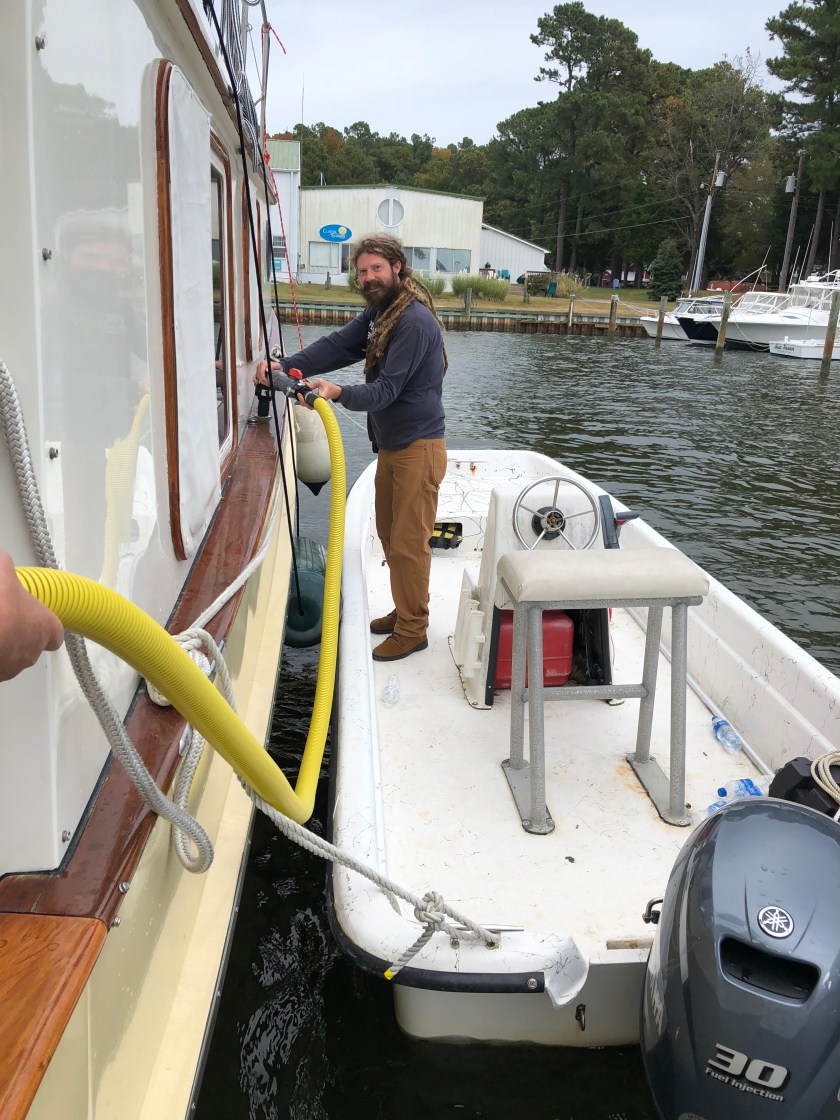
Here comes Isaac the dockhand to the rescue. He comes around in the work skiff, ties up to the side of the boat near the tank access, we hand him the pump out hose across our cockpit and viola! pump out. Well, not quite viola! as it took a bit more work than usual. It appears we had a clog in the line and the vavuum power at this marina is not robust on the outer docks. Overall, not a big deal. But, you just have to work the steps to the solution.
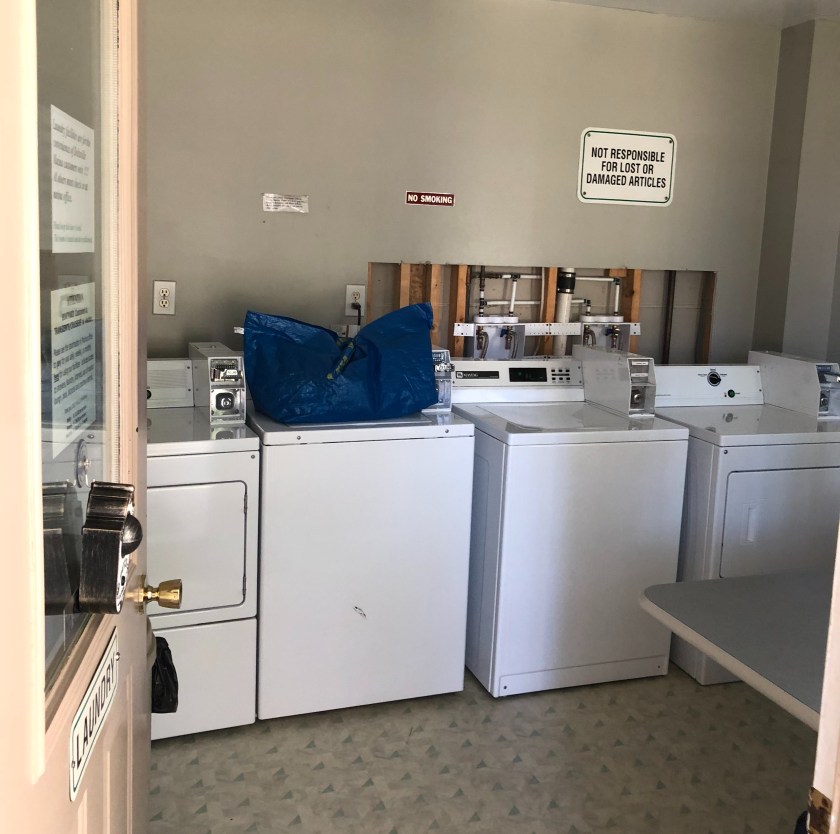
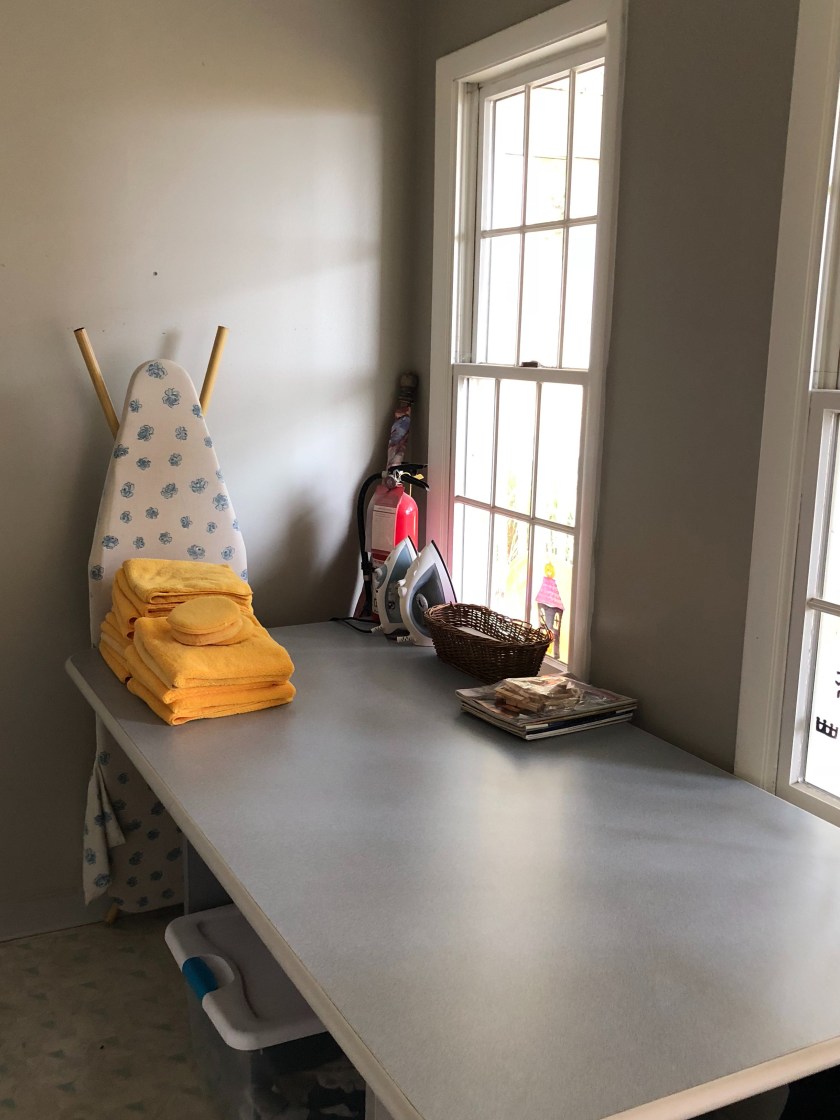
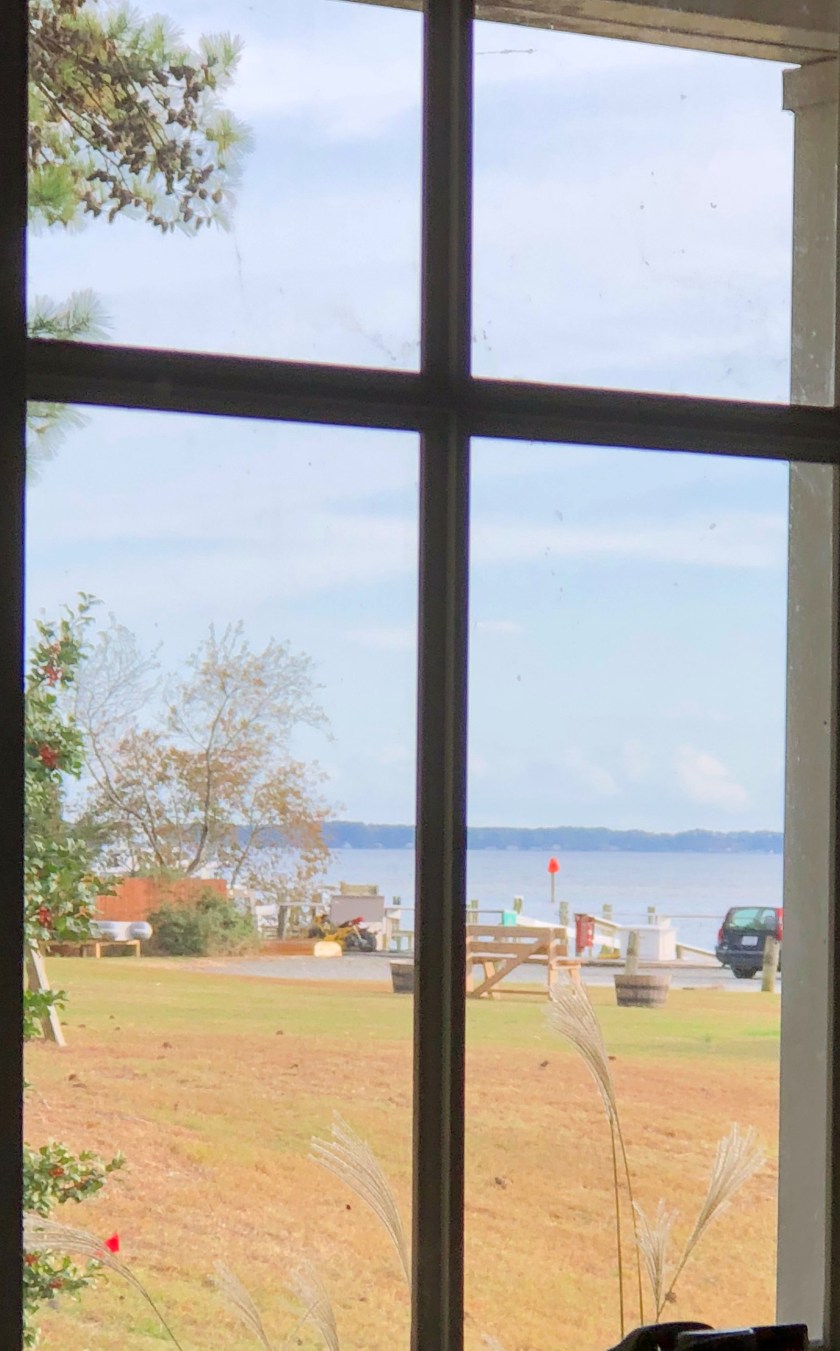
Laundry: Sabrina does not have a washer/dryer on board. So we have to use the laundromat at the marina. Most marinas have them. This one is pretty nice. Decent machines. $1.50 for the washer and $1 for the dryer. We stocked up on quarters, so we’re good there. There’s a folding table, an iron and ironing board, and a little porch where you can sit and watch the water while you wait. Or set a timer and go back to the boat and come back with your laundry is done.
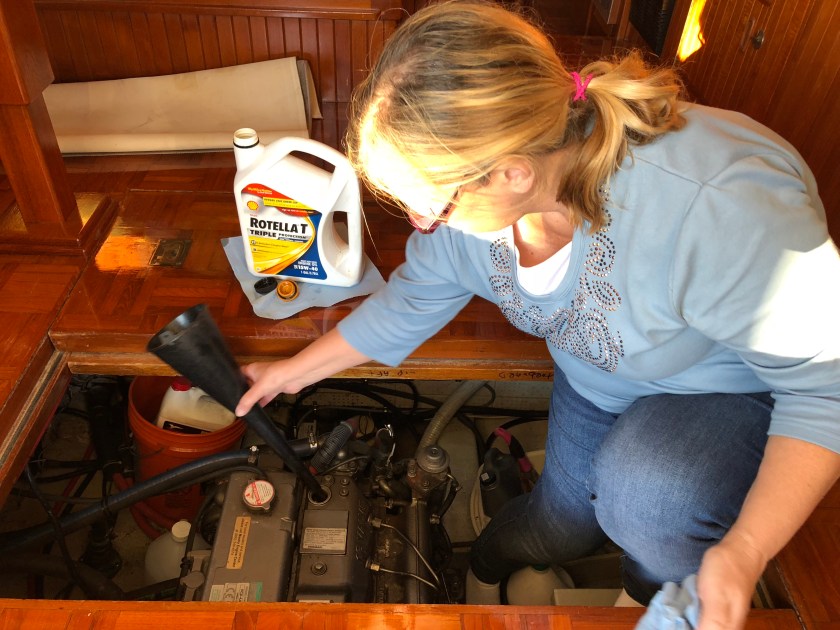
Engine checks and maintenance: Every time we leave port we need to check the oil in the engine, the cool water intake strainer (to make sure it’s not clogged with seaweed/grass/bits of plastic bag, barnacles, etc), the coolant levels and the fuel filters.
Filling the water tanks: We have a water filter and a water softener we hook up when we fill the fresh water tanks. This is the water we drink, use to wash dishes, take showers and flush the toilet. We carry 300 gallons. You might be surprised how fast you go through it and how fast you learn to conserve it when you have to physically replace it. There’s also a special white hose you use to fill the tanks instead of garden variety, well, garden hose.
Cleaning (interior and exterior): It’s a universal mystery how a boat interior gets so dusty. I can vacuum and mop (and I mean on my hands and knees clean the floors since it’s only about 150 sq ft of floor space) and the next hour POOF it’s back. Luckily, it doesn’t take more than 15 minutes to clean the floors. Then there’s the exterior floors and sides of the boat. That’ll be another post.
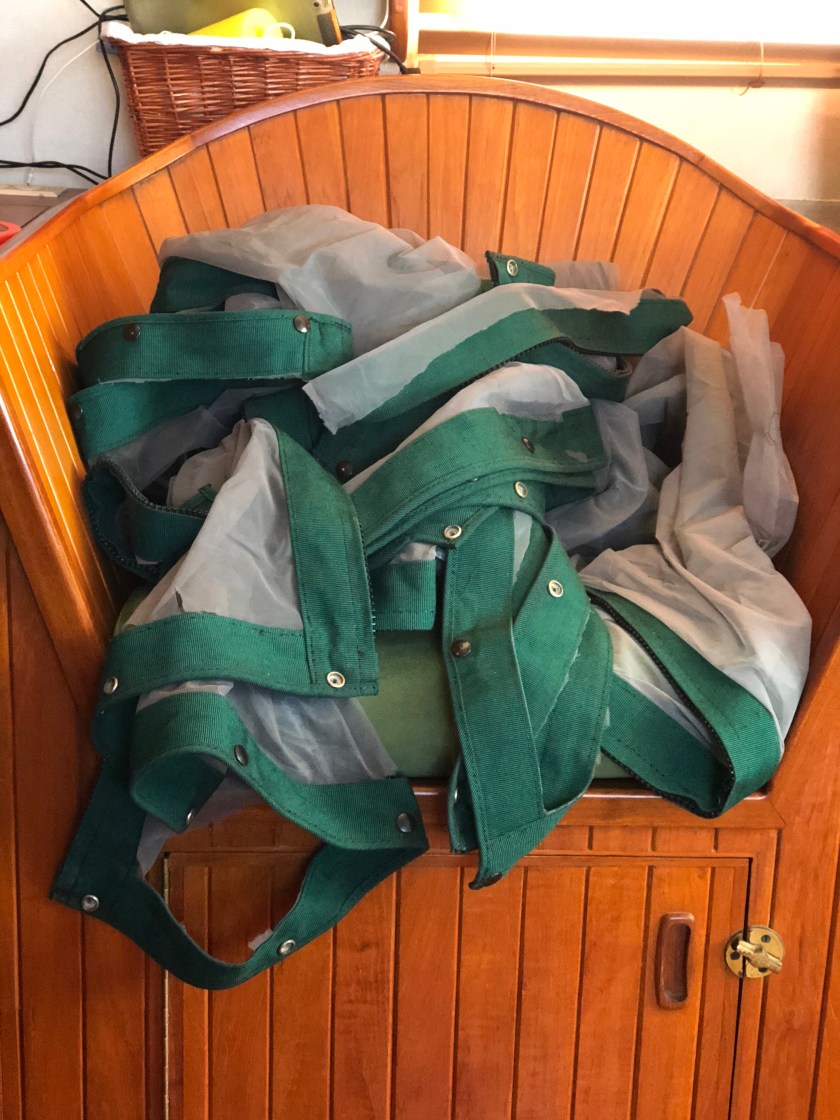
Canvas repair: We have canvas screens to enclose the cockpit. But, the mesh is 20+ years old and dry rotted. The Sunbrella canvas is solid. So, one project is for me to replace the mesh inside the existing canvas frames. I spent one evening picking out seams from 2 of the 7 panels. Little bits of black thread everywhere. I’ll write another post when I’ve ordered the mesh and start sewing. Yes, I ended up bringing my sewing machine on board. Turns out lots of boaters have a sewing machine on board.
Provisioning: This is pretty much grocery shopping and stocking the pantry. But, with days or weeks without access to supplies in mind. Or no way to just run out to the grocery. We’re a coastal cruiser and not a passage maker which means we’re not going 20 days without sight of land. How you provision is based on how often we plan to anchor out vs stay in marinas where you can get to grocery stores or restaurants. And you have to take into account what you can store on board (think perishables as well as the space needed) and how you can cook them. We have a refrigerator and freezer and an Rtic ice chest so we can store a fair amount of food. And we have a cook top (used it the other day for the first time!), an oven, microwave, toaster oven and a small gas grill as well as a crock pot so we can cook pretty much anything we want. A boat buddy at Deltaville had a rental car so we took a ride to the Walmart Super Store to stock up. We’re going to travel together for a while and they really like to anchor out instead of staying in marinas. So, we wanted to make sure we had enough on board to do that if we wanted. We tend to want to stay at marinas more. But, then that was before we were full time. Things can change.
I’m sure we’ll talk about boat chores again in another post.
– Kitty
 MV Sabrina goes ...
Makes me tired to think about it!
LikeLike
Me, too! ❤️
LikeLike
OMG this is so interesting. I’m loving reading about your adventure. You’re both great writers and really paint a clear picture of what you’re dealing with. It seems both scary and exciting. I’m glad that it will be getting calmer from here on out. Stay calm and carry on. ❤🙏🍷
LikeLike
I’m so glad you’re enjoying it! We can’t wait to have you guys on board again!
LikeLike
Sorry about this past SEC weekend. We thought of you two and felt you might pull off the upset.
But you have your trip to focus on!
Roy Van Brunt royvb@aol.com
LikeLike
Yep, much of what you describe is very similar to life on an RV (or a camper parked permanently for tailgating at NSU). Remind me to tell you about the time some pump switch was on, coupled with a full black water tank, and I flushed. Nevermind, DON’T remind me!
LikeLike